
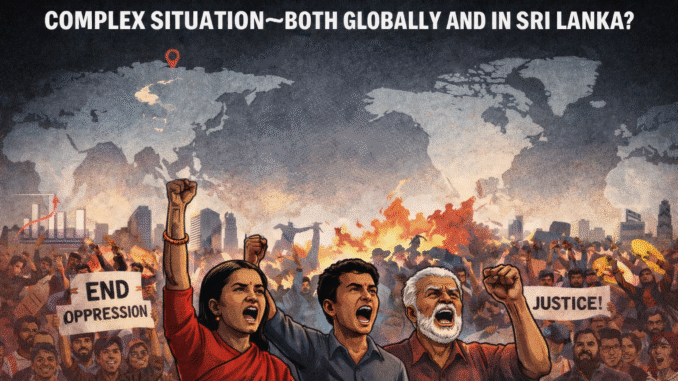
What Should Be the Priorities for Tamils in the Current Complex Situation—Both globally and in Sri Lanka?
Draft for Discussion Among Left Parties, Tamil Organisations, and Activists
Tamil Solidarity fully endorse this statement from the United Socialist Party
1. World relations have become significantly more complex during this ongoing economic crisis, as various powers compete intensely, leading to rapidly changing geopolitics in Asia and the South Asian region. The authoritarian character of capitalist states is on the rise, and there are no long-term, stable, or reliable alliances among them. This situation has prompted an increased drive towards state militarisation in preparation for war and conflicts. Another key feature is the growing polarisation both between nation states as well as within states between workers and the rest of the marginalised society on one side, and the capitalist class on the other, within each nation.
2. Indian state dominance in the South Asian region has significantly increased during this period, coinciding with its rise as the fourth-largest economy in the world. In contrast, neighbouring nations, including Pakistan, are grappling with severe economic crises, having either stagnated or entered recession, while the Pakistani military, which in reality runs the state, has strengthened its ties with US imperialism and at times with China. The Modi regime is known for its brutal repression of workers and marginalised groups in India, while its foreign policy focuses on two key aspects: creating favourable conditions for its wealthy capitalists, such as Ambani and Adani, and establishing military dominance in the region. Although Chinese expansion efforts, including the Belt and Road Initiative (BRI), have been constrained by various evolving situations, particularly within China, it continues to aggressively pursue its interests in the region. The BRICS nations appeared to offer a significant counterbalance to U.S. and Western interests, as well as the dominance of the dollar; however, their internal instability and contradictions, particularly in South Asia, remain exposed.
3. Smaller economies such as Sri Lanka cannot overcome the geopolitical waves of the region, nor can they navigate “successfully” by balancing among the powerful interests in the region, as is currently claimed by the government and others, including the so-called opposition.
4. The bankrupt Sri Lankan economy is held together mainly by handouts and bailouts. Interventions by international organisations such as the IMF, along with secret dealings and agreements with India and China—reportedly involving the handing over of parts of the country and significant sectors of the economy in return for loans and the postponement of debt payments—have so far kept the country afloat. The economic crisis and the subsequent social crisis have not been resolved; rather, the dangerous “can” has simply been kicked further down the road to buy time.
5. The Anura government came to power riding the expectations generated by the massive Aragalaya uprising of 2022, which dismissed the entire political elite of the country. However, the government has had nothing substantial to offer to meet those demands and has chosen to remain imprisoned within the capitalist system. It is the lack of a viable alternative, combined with the continued discrediting of the extremely corrupt right-wing opposition parties, that has allowed the government to maintain some support, as some still hope it should be given more time to deliver.
6. While presenting itself as “Marxist” and on the side of workers and the most oppressed sections of the country, the JVP-led NPP gained electoral support. So far, the focus of the government has been on adopting some populist measures and presenting itself as a “reliable” and “clean” alternative for the middle class and sections of the capitalist class. It is very clear that this JVP – NPP government is not different from previous capitalist governments, as they fully follow the directions of the IMF and WB to implement the neo liberal programme. In reality, it has become a “caretaker” government—managing the anger and expectations of the masses while providing enough time for the vultures of the old political establishment to prepare their own return.
7. Delaying significant debt repayments until the next presidential election in 2028, along with other “kick-the-can-down-the-road” measures, will not be enough to maintain social peace. The burning issues are already beginning to find expression through strikes, protests, and even discussions about the possibility of mass action.
8. The so-called “Marxist government”—a gross misnomer—has given its strongest indications yet of how prepared it is to silence opposition from any quarter using all available powers, including the executive presidential powers that the JVP/NPP originally built support by opposing. This is a real and growing threat faced by all opposition forces- including the working class and the Left organisation. It is also clear that the NPP government is not prepared to abolish the dictatorial presidential powers.
9. Tamil-speaking communities—the Hill Country Tamils, Muslims, and the Tamils in the North and East—face a bleak future. The chauvinist incident took place in Trincomalee, where one of the most notorious racist agitators in the country was openly protected, alongside the government’s response to Cyclone Ditwah, has ripped open the real face of the NPP/JVP government.
10. The core of the JVP is still dominated by the Sinhala chauvinism it has upheld throughout its history. They are even prepared to abandon their long-standing “anti-Indian” stance for opportunistic reasons (in reality, they never appealed to Indian workers; while now they openly embrace the Indian capitalist class). Yet when it comes to the rights of Tamils, there has been no change in policy—not an inch of progress.
One should not forget the second insurrection led by the JVP during the 1988–89 period under the name Deshapremi Janatha Viyaparaya (DJVP). During this time, many left activists and trade unionists who supported the Indo–Lanka Accord were killed. The JVP also openly campaigned against the establishment of the Provincial Council system introduced under the 13th Amendment.
11. The Tamil-speaking population voted in significant numbers for this government, clinging to a hope-against-hope expectation that it would not only address economic hardships but also deliver on long-standing democratic demands.
12. Delaying provincial elections, protecting or promoting alleged war criminals within the government, refusing to take concrete steps on the issue of missing persons and past atrocities, and pushing back on the use of the Tamil language—for example, cyclone warnings not issued in Tamil despite the Hill Country being among the worst affected areas, or frequent instances where Sinhala and English are prioritised while Tamil is relegated to a distant third—have all contributed to growing Tamil discontent. Many government functions, meetings, and press events take place entirely in Sinhala, with no Tamil or other language interpretation provided. These are only a few of the issues fueling frustration.
This also exposes their deeply rooted communal mindset that is prominent within NPP. The postponement of the Provincial Council elections is not a technical issue; rather, it reflects the NPP government’s internal debate over whether to abolish the Provincial Council system altogether.
13. The Tamil representatives of the NPP have become increasingly discredited due to their lack of understanding of political processes and their inability to deliver on the promises they made to get elected. Many Tamils—particularly in the North—now recognise how they were misled by nationalist rhetoric and the empty assurances offered by these individuals. They are largely accidental political figures who had no organic connection to society nor emerged from any sustained mass work. Even so, they had an opportunity to fight for Tamil interests. Instead, they have become subservient to the JVP’s historically chauvinist position, preaching the need to remain “united” while effectively positioning themselves against Tamil democratic rights, including the national aspiration.
14. Sections of the right-wing Tamil political representatives, who maintain close links with their pro-capitalist counterparts in the capitalist UNP or SJB, have so far failed to articulate any meaningful strategy for advancing Tamil rights. Their mild opposition to the government is motivated more by the desire to secure influence and political space than by a commitment to representing Tamil interests—let alone the broader interests of all oppressed sections in Sri Lanka.
15. The main Tamil alliance of the past, the TNA, is now largely resigned to history. Its key constituent party, the ITAK (Federal Party), is riddled with internal conflicts and confusion. They still maintain a position of negotiation and engagement with the capitalist government in the south—supposedly to advance Tamil rights—their primary concern is also preserving their electoral relevance. They rely increasingly on populist and nationalist rhetoric for electoral gain. Their current leader, who does not hold full authority within the party, stands accused of corruption and has gained a reputation for empty rhetoric.
16. In this vacuum, the TNPF has gained some ground in the North primarily on the basis of Tamil nationalism. However, their positions on socioeconomic issues remain largely unarticulated, and it is unclear to what extent they will be trusted on economic matters, given their support for capitalism, given that they have not acted beyond narrow nationalist lines. Moreover, their influence remains largely confined to parts of the North. They do not consider launching a common campaign with the working class in the South against repression. With such limited reach and without an appeal broad enough to build a wider struggle for Tamil rights, it is unclear what concrete strategy they offer for securing those rights.
17. Tamil-led parties, however, remain united in their false hope that the United Nations will somehow deliver justice on human rights violations, or in the illusion that the Modi regime, the United States, and Western capitalist governments will intervene meaningfully. Diaspora Tamil lobbying groups have reinforced this false hope within the community. Despite highlighting atrocities and human rights abuses committed by past capitalist governments, the diaspora lobby has achieved very little. As in Sri Lanka, diaspora politics are dominated by right-wing pro-capitalist elements seeking to build their own electoral bases. This is evident in Canada and Australia, where mobilising a Tamil bloc vote in their new countries has become a central objective behind much of the rhetoric and activism.
18. Sixteen years after the end of the war, no lessons have been learned about how international bodies and these governments will not deliver fundamental rights for Tamils in Sri Lanka. Another sixty years may pass with the same promises and pretences of “standing for human rights” without delivering even a single meaningful step forward—unless the character of these governments and institutions fundamentally changes. The majority of right-wing diaspora organisations focus on raising money and spending it on futile lobbying efforts. Tamil community resources are wasted on sustaining false hope, while little to nothing is invested in educating the community about the bankruptcy of the Modi, Trump, Chinese, or Western regimes. No significant resources are spent on building struggle, organising resistance, or empowering the Tamil community to fight back.
19. The Sri Lankan government completely failed the Tamil community after spending enormous resources on war and destruction at the expense of Sinhala workers, the poor, and all others. An equal or greater amount should have been spent at least to rebuild lives afterwards. Instead, the responsibility for rebuilding has largely been left to the Indian government hand-outs (which is, of course, to secure their own interest) and diaspora assistance. Moved by the horrors unleashed on Tamils by the Sri Lankan military offensive under the Rajapaksa regime—supported at the time by the JVP—the Tamil diaspora opened their wallets generously and came to the community’s aid. Countless hard-working Tamil workers contributed, particularly in the North, providing some relief. While this played a vital role in easing the suffering of thousands of families during and after the war, it also had a counter-effect on Tamil political mobilisation. It reduced Tamil “political activism” to mere aid distribution. Tamil political parties in Sri Lanka have also conveniently adapted to this, as they too are not focused on building a struggle to win Tamil demands. Everything has been reduced to “providing aid,” lobbying the UN to pass one resolution or another, and similar symbolic gestures. Given the dire economic conditions most Tamils are forced to live under, it is unsurprising that illusions in India and the West—and reliance on aid—continue to dominate Tamil consciousness.
20. The political strategies of Tamil parties are restricted to navigating between geopolitical powers. They argue that India needs the Tamil population to assert its interests in Sri Lanka and that aligning with India will somehow advance Tamil rights. Some even promote the idea of cultivating Tamil Hindu nationalism to appeal to the Modi regime. No leading Tamil politician has come forward to expose the emptiness of this argument. None is willing to campaign among Tamils to dispel these illusions or to build awareness about the need for a united struggle. The Indian regime, which is carrying out enormous attacks on workers and minorities within India itself, will never act in the genuine interests of Tamils in Sri Lanka, as has been shown in the past. The claim that Tamil leaders can somehow “navigate” geopolitical interests is another lie. Even at the height of the international exposure of the Rajapaksa clan, neither the Indian government nor any international institution took meaningful action. Their primary goal is to “engage” the Sri Lankan government to advance their own strategic interests. They use human rights merely as a diplomatic tool. Creating awareness of this reality among Tamils, and appealing to workers and oppressed minorities in Sri Lanka in the south and in India for a united struggle against these regimes, is vital—yet none of the Tamil leaders are prepared to take up this task.
21. The absence of a clear political strategy among Tamil leaders and major organisations is not only due to electoral calculations but is rooted in their class interests. Unlike in a brief period of the past, most no longer see any alternative beyond capitalism. Their failure to understand the state as an instrument of capital, and to recognise that oppression is rooted in capitalist structures, drives them to seek reforms through the capitalist state rather than building a revolutionary struggle against it. This is why none of them are interested in putting forward a clear strategy or engaging in public debate about what is needed to advance the Tamil people’s interests. None has explained how Tamil rights can supposedly be won through the UN, or with support from Trump, Modi, or any other capitalist power.
22. This failure is reinforced by the rotten role played by the so-called left, past and present. With the exception of the United Socialist Party (USP), none of the left organisations have accepted the national demands of the Tamils. Despite progressive rhetoric, the front-line socialist Party (FSP) also falls short of supporting the national rights of Tamils. The gross betrayal by the LSSP and the Communist Party was followed by the JVP, whose leaders were willing to carry out a murderous campaign to prevent Tamils from securing even the most modest political rights. In the late 1980s, the JVP formed armed groups to oppose the 13th Amendment. While this India-led constitutional change is itself inadequate and far removed from the national aspirations of the Tamils, even this limited reform was opposed by organisations that falsely call themselves “Marxist.”
We maintain that the 13th Amendment is not a solution to the Tamil national question. However, Marxists do not stand in the way of democratic advances, however limited they may be. Therefore, in this context, it is correct to demand the immediate implementation of the 13th Amendment and to insist that democratic elections be carried out—without creating any illusions in its capacity to resolve the national question.
Tamil parties have at times articulated the demand for a federal structure and, more recently, have included within it the right to self-determination. Even these demands cannot be achieved without mobilising the Tamil masses and, at the same time, appealing to Sinhala and other communities. Without such political work, these demands will remain abstract or merely decorative. While rejecting the unitary state constitution that denies fundamental rights and while demanding full democratic rights for Tamils, the fundamental point remains that we do not oppose any democratic gains for Tamils, however limited they may be.
It is also correct to support the demand for a merged North-East administrative unit. This demand was opposed by the JVP, which went to the Supreme Court seeking an order to divide the North and the East. The USP was the only party that went to court opposing the JVP’s demand. However, support for the merger must not come at the expense of the Muslim and other communities living in the East, whose rights must be fully defended.
Without winning mass support on the ground, such demands cannot be realised. The rights of all workers and the poor in these regions must be integral to the struggle. No constitutional change will secure Tamil rights unless it is backed by a united mass struggle of Tamil, Muslim, and Sinhala workers and all those exploited by capitalism. This is a core element that must be included in any serious strategy to win democratic and national rights.
The struggle for national rights—including special or national rights for the Muslim people—must not be conceived in a restrictive manner. On the basis of a united struggle and the full recognition of rights for all communities, Tamils could voluntarily choose to be part of a confederation that democratically plans and allocates resources for the benefit of all. Achieving such unity is not only entirely possible but would also have a profound impact across the South Asian region, pointing the way toward a South Asian Confederation of socialist states.
To reiterate, while working toward these broader aims, Marxists welcome any advance in democratic demands. However, each such gain must be used as a stepping stone to strengthen the struggle and push forward toward more decisive advances.
23. Much of the Sri Lankan left—including those who claim to oppose the NPP government—fails to articulate Tamil demands clearly. Although the socioeconomic issues affecting Tamils are vital, they alone are not enough. Tamil national aspirations—linked to language rights, cultural rights, and other democratic rights—must also be addressed. Support for the right of Tamils to political self-determination is essential if there is to be any hope of building a united struggle.
24. What is needed is a united and farsighted programme to build a struggle for the rights of all oppressed communities, including the national rights of Tamils, not another electoral bloc formed for short-term gain.
25. Any organisation serious about Tamil rights must come forward to form a united front based on a clear programme—one that articulates socioeconomic advancement for all while firmly upholding Tamil democratic and national rights.
What we recommend
- Call a meeting of all those willing to come forward to build a strong, united struggle to advance Tamils rights, including national rights.
- Hold a public discussion on what the programme should be and the key demands that must be taken up.
- Form an uncompromising alliance based on this programme, with the aim of acting collectively as a united front. This alliance should seek to include representatives from all communities.
Develop a strategy to win these demands. This must include appealing to Sinhala, Muslim, Hill Country, and other minority communities on the basis of a programme that also defends their rights and meets the economic and social needs of all. Appeals should also be made to all workers’ organisations, including trade unions, urging them to take a principled stand and advance these demands among their members. The movement should further extend its appeal to the struggling masses across South Asia.
Conduct an educational and awareness campaign among Tamils and across all communities to explain and popularise the programme.
Direct resources toward this campaign work and toward building the forces of struggle—strengthening the alliance among the masses and laying the foundation for a sustained fightback with the objective of forming a government of the workers and poor with a socialist programme to support the democratic and economic rights of all.