
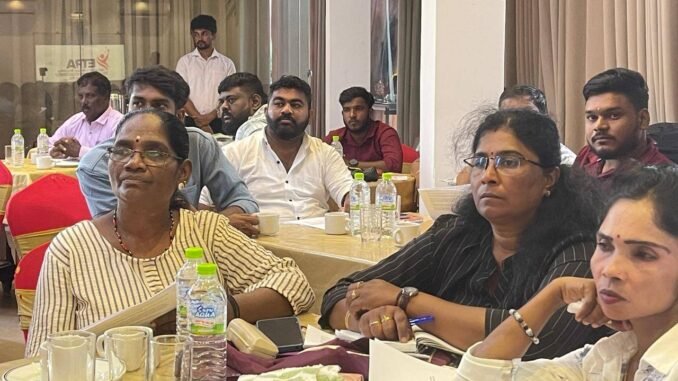
Newly formed Eelam Tamil Rights Assembly (ETRA) recently published what it believes should be a “core principle” statement for those advocating Eelam Tamils’ rights. Their lengthy document, “Core Principles on the Exhaustion of Internal Remedies and the External Resolution of the National Question of the Eelam Tamils,” has two parts: a preamble that reviews key historical points related to the Eelam struggle, and a declaration — the “Trincomalee Declaration,” released at a February press conference by activists in Trincomalee.
First, we welcome such an initiative and the transparency about position and strategy. Open debate and discussion about perspective and strategy must take place among Tamils with a view to building mass participation and an effective fightback to win rights. With that in mind, below we outline some points after reading this declaration. Please see our comments regarding the preamble in the appendix.
The main weakness of the document is its reliance on, and strong emphasis upon, so‑called “international law” and powerful capitalist nations. Tamils do not need to reaffirm their inalienable right to nationhood based on laws designed to protect the interests of the states that dominate the international market and its affairs. We are living through a period in which these legal frameworks are shown to collapse when the interests of those states are challenged. We should never subordinate the inalienable rights of Tamils to the profit interests of economically powerful nations.
It is correct to reject reliance on so‑called “internal constitutional” arrangements — whatever form they may take — to deliver the national demands of Tamils. It is equally true that international constitutional arrangements or any supposed external protections will not deliver for Tamils or other nationally oppressed peoples at this stage, unless doing so aligns with the wider economic or geopolitical interests of dominant states. To subordinate our struggle to such hopes risks repeating the errors of lobbyist circles that have refused to build a powerful Tamil fightback, instead promoting illusions and false hopes in international institutions.
Hence the declaration’s faith that any “political settlement” will endure if it is “internationally guaranteed, legally binding and subject to effective international oversight” is deeply misplaced. In a striking lack of foresight, the declaration also places undue hope in the International Criminal Court (ICC) at a time when all such institution faces significant challenges from the very powers it has historically served. Ample evidence — from Sudan to the DRC, Kurdistan to Kashmir to Palestine, and elsewhere — shows how these institutions has often failed to deliver justice for oppressed peoples. We should not divert further Tamil energy and resources into this largely hopeless exercise.
How can the “political will of Tamils” be “negotiated” under “international mediation”? Who would these mediators be — Norway again? Modi’s India? Trump‑led US? the EU? Canada? China? Many of these states and international bodies, including the UN, are cited as having “international responsibilities” because of their past mistaken or complicit roles in Sri Lanka and against Tamils. This is fundamentally a moral argument. Imperial states and economically dominant nations have committed war crimes, genocide and crimes against humanity across history and continue to do so. If we were to hold them bound by a moral claim of “responsibility” for past heinous crimes, most of their leaders would be in prison and powerful nations would be acting to serve the masses rather than private profit. That is wishful thinking. That is not how world relations are dictated. We should not excuse colonial crimes or imperialist interventions, but relying on such actors to take “moral responsibility” as the core of our strategy is unrealistic.
Furthermore, there is no such thing as “internationally recognised guarantees” that will reliably deliver for an oppressed nationality. No foreign mediator is going to draft a domestic constitution for Sri Lanka with the Tamil nation in mind and then force Colombo to accept it. We should analyse and have wider debate about why this will not happen: such discussion would help shatter illusions and assist the building of mass struggle. Maintaining the illusion of outside salvation only further pacifies the need for grassroots mobilisation.
While correctly rejecting the Sri Lankan constitution and false efforts to secure “constitutional solutions” within the framework of a unitary capitalist state, the document nevertheless reassures readers that it is not an “advocacy of separate state” and refers to article 157A. While it is understandable that actors may operate within “legality” to avoid persecution by the Sri Lankan state, it is not necessary to reach a definitive conclusion about advocacy for separation at this stage in negative. The same logic applies to all Tamil parties operating within Sri Lanka: when the right to self‑determination is exercised by the masses, in practice it results in the creation of a separate state. This is not merely a constitutional debate.
Framing the right to self‑determination as something to be resolved through a “pre‑constitutional agreement” under “international mediation” reflects a confused position. The document fails to explain what a “pre‑constitutional agreement” would actually be, beyond asserting that Tamils should not abandon the demand for nationhood and should retain the right to exercise it via referendum. This something that everyone desire and articulate. But how this will come to pass?
Domestic constitutional discussion is far more complex than that. If the document sets parameters or ultimatums for participation in constitutional talks, it must also say what the Tamil masses should do if those parameters are rejected. Given that any Sri Lankan government that maintains power on chauvinism and Sinhala‑Buddhist nationalism — and that acts in the interests of capital — will never accept such parameters, it is crucial to outline the next steps the masses should take. Here lies the strategic weakness of the document.
Like right‑wing Tamil leaders in the past, this strategy risks keeping Tamils outside political processes and ultimately accepting the “fate” imposed from Colombo. Strategy must not be an either/or choice; it must build a fight on every front and at every stage.
Tamil masses inside Sri Lanka should demand full democratic rights, including the right to self‑determination. Engagement in discussions over a supposed “new” constitution must encompass all rights — not only national rights for Tamils but rights for all ethnic and tribal groups in Sri Lanka. Under no circumstances should Tamils agree to a constitution that aims to punish or strip significant rights from any ethnic group. We must oppose attacks on all oppressed sections, including the rights to land and decent wages for hill‑country workers and the poor, and defend the welfare of the Sinhala working class.
Talk of “domestic” negotiation or “constitutional” agreements is meaningless if Tamils keep themselves outside the broader struggle for well‑being and democratic rights for all. Tamil demands for national rights must advance from this — not apart from — that broader, united struggle. While rejecting the so‑called “unitary” state, we should build a mass struggle for all rights, seeking alliances with the Sinhala working class and all oppressed sections, and appeal for solidarity with movements across the region and internationally.
Tamil strategy must change and become universal. We cannot support one people’s oppression while prioritising another’s; we cannot place faith in the Modi regime while denying the rights of Kashmiris and other nationalities, then expect Modi‑led India to act “morally responsible” on Tamil rights in Sri Lanka. Almost all so‑called Tamil parties have aimed to walk the corridors of the UN; everything is reduced to lobbying supposedly great external powers without any serious critique of them.
Young Tamils stand for universal rights, including the right to nation for Palestinians, Kashmiris and all oppressed peoples. Double standards are exposed, and those who fight back against oppressors must recognise that human rights are universal. This new generation will therefore refuse to carry the nationalist banner of any ruling power or to view external states as saviours. Instead, they will seek to build links and powerful alliances across communities and borders. Unless such a strategy is clearly articulated, any new formation will remain old in outlook.
Appendix
Points regarding the preamble section of the document
The preamble is neither a theoretical framework nor a comprehensive historical account of the Eelam struggle. Rather, it is a selective summary of what ETRA has preserved as important. The historical development of the Tamil language, culture, and the emergence of Tamils as a national group cannot be treated in definitive terms here; these topics remain subject to ongoing research, and space should be left for further scholarly investigation and refinement. For example, stating “Tamil homeland through colonial conquest beginning in 1619” as a statement of fact claims the existence of a well-defined Tamil homeland prior to the colonial period. Tamil activists often conflate the modern nation‑state with earlier feudal kingdoms and present the latter as though they are identical and therefore must be defended uncritically. Reality is much more complex.
Even from the perspective of establishing historical continuity, it is wrong to present the past as a single “coherent political and territorial entity.” Nowhere in Sri Lanka, not even in Kandy, did a fully formed, coherent political and territorial entity exist in the modern sense. The nitty‑gritty of the formation of feudal lords and kingdoms and how they were structured should be left to historical scholarship. There is no need to go into those detailed debates to establish the fact that Tamils have lived in the North and East historically — that has never been in dispute.
Defining clear borders of a “modern” Eelam cannot be done simply by redrawing the boundaries of ancient kingdoms and feudal polities. Modern boundaries are defined for administrative and electoral purposes and thus will not be adequate when it comes to drawing the “line” for a new nation; that may have to be left to the future.
As for the various constitutions introduced since the colonial period, they were in all cases imposed from above. At times this was supported by elites from various communities. Neither Sinhala‑ nor Tamil‑speaking populations were meaningfully included in constitutional enactment processes. In fact, elites — including sections of the Tamil elite — pleaded with the British to exclude the majority of the population, including women, from any plebiscite. It is wrong to present the Tamil community as a homogeneous entity.
Regarding the period from independence to the emergence of armed struggle, we can agree that numerous attempts to find an acceptable settlement failed, mainly because right‑wing politics relied on Sinhala‑Buddhist chauvinism for their survival. However, there must also be a critique of the Tamil elite, many of whom sought electoral gains above all else. None of them pursued a clear strategy to build a mass struggle for independence or to win full rights. This failure is central to the problem of the Tamil political elite and contributed to youth rejection of those leaders. So‑called “non‑violent” struggles comparable to India’s did not exist in Sri Lanka; resistance to the Sri Lankan state existed, but it was largely tailored to electoral gains. Tamil leaders often relied on fasts or protests that functioned more as stunts than as sustained mass struggle. They did not mobilise the Tamil masses nor attempt to secure genuine popular consent for their political decisions and capitulations. It was never a mass Tamil struggle. Future generations seeking to build a strong mass movement should not defend these past mistakes.
We must move beyond the oversimplified narrative popular among an ill‑informed older generation: that Tamils existed as a single unified kingdom; that colonial powers “gave” independence to Sri Lanka and transferred power to the Sinhala community; that Tamils then pursued a separate homeland by non‑violent means which failed, forcing them to take up arms; and that great powers who aided the Sinhalese should now be expected to take moral responsibility and establish Eelam.
This gross simplification politically misrepresents history and serves to justify past and present political errors. It conceals class differences and other inequalities, and how elites have used Tamil demands for rights to further their own ends. Asking the Tamil population to accept a “pure” past also serves to justify current capitulations by Tamil leaders as if they were a new stage of struggle. As in the past, present‑day Tamil leaders — both self‑appointed and elected — sit through repressive legislation and changes without urgency to mobilise the Tamil masses. They appear content with endless “negotiations” and social engagements with Sinhala counterparts in government. A new struggle cannot be built by hiding these facts.
Consider one historical event as an example. When the TNA decided to endorse the very general implicated in the 2009 massacres — just after those mass killings, even before the blood had dried — a small section of Tamils protested. Tamil Solidarity highlighted this as another electoral manoeuvre without any long‑term plan to build a genuine Tamil struggle. TS called for “not TNA” and demanded a collective effort to build a viable political alternative. The establishment attacked that slogan as “divisive” and accused it of undermining “Tamil unity.” In hindsight, it is clear why an alternative stance was necessary at that time. TS also made clear that it did not argue for the complete dismantling of the TNA as an organisation, but opposed its political bankruptcy and insisted on the need to build a viable alternative. The Tamil community is not homogeneous, and unity at all costs should be rejected. Unity must be forged through struggle, based on perspective and strategy.
There is, however, a strong desire for unity in the Tamil community: a dominant idea that everyone should set aside differences and come together to demand rights with one voice. This sentiment is often exploited by the Tamil elite to demand support regardless of their mistaken positions. External actors — Indian or Western establishments — also urge Tamils to “come together,” often to serve their own interests. The Tamil community is one of the most cohesive in the world, forged by a shared desire for democratic and national rights. Those who preach “unity” as though cohesion already exists among others are often seeking to exploit that unity for electoral or other ends. We should reject the idea of unity at all costs and instead aim to bring together all those willing to struggle on a principled political basis.