
Oxford/Cambridge union debate cancellation
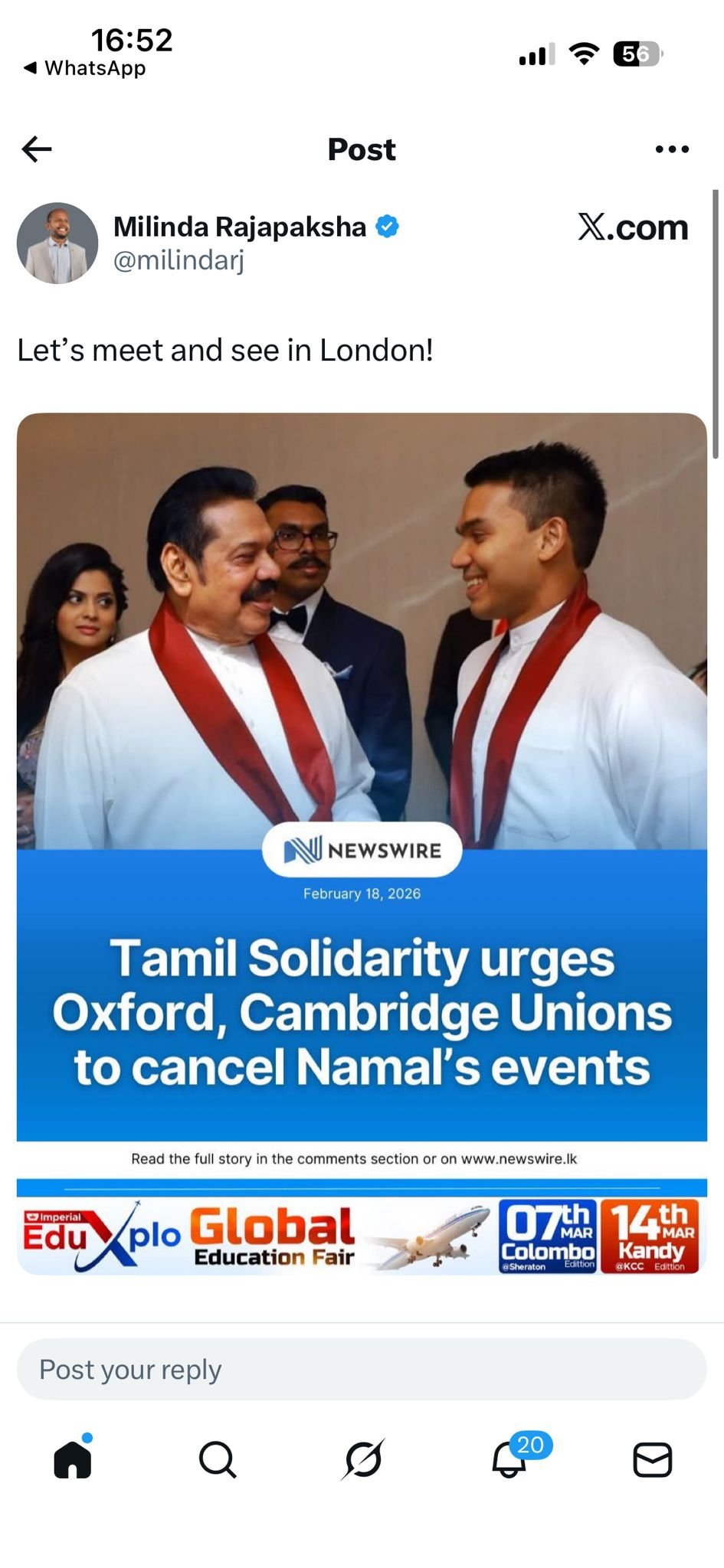
Various student and youth groups (not all exclusively Tamil), including Tamil Solidarity, demanded that Oxford and Cambridge unions not provide a platform for Namal Rajapaksa, aware of how he and the SLPP would use it to build his image. It was also pointed out that many students and their families studying at these institutions are victims of Rajapaksa‑led crimes. If the event went ahead, protesters warned they would organise mass demonstrations.
What motivated hundreds—if not thousands—of students to turn out in protest? It was not personal hatred of an individual but political outrage at gross injustices against the Tamil community. This opposition was broad, not a small fringe: most active Tamil diaspora groups united in resistance, and many other students and youth—including Indian and Palestinian activists—joined them.
[See below for details on who Namal Rajapaksa is, the allegations against him, and why he is opposed by people of all ethnic groups in Sri Lanka]
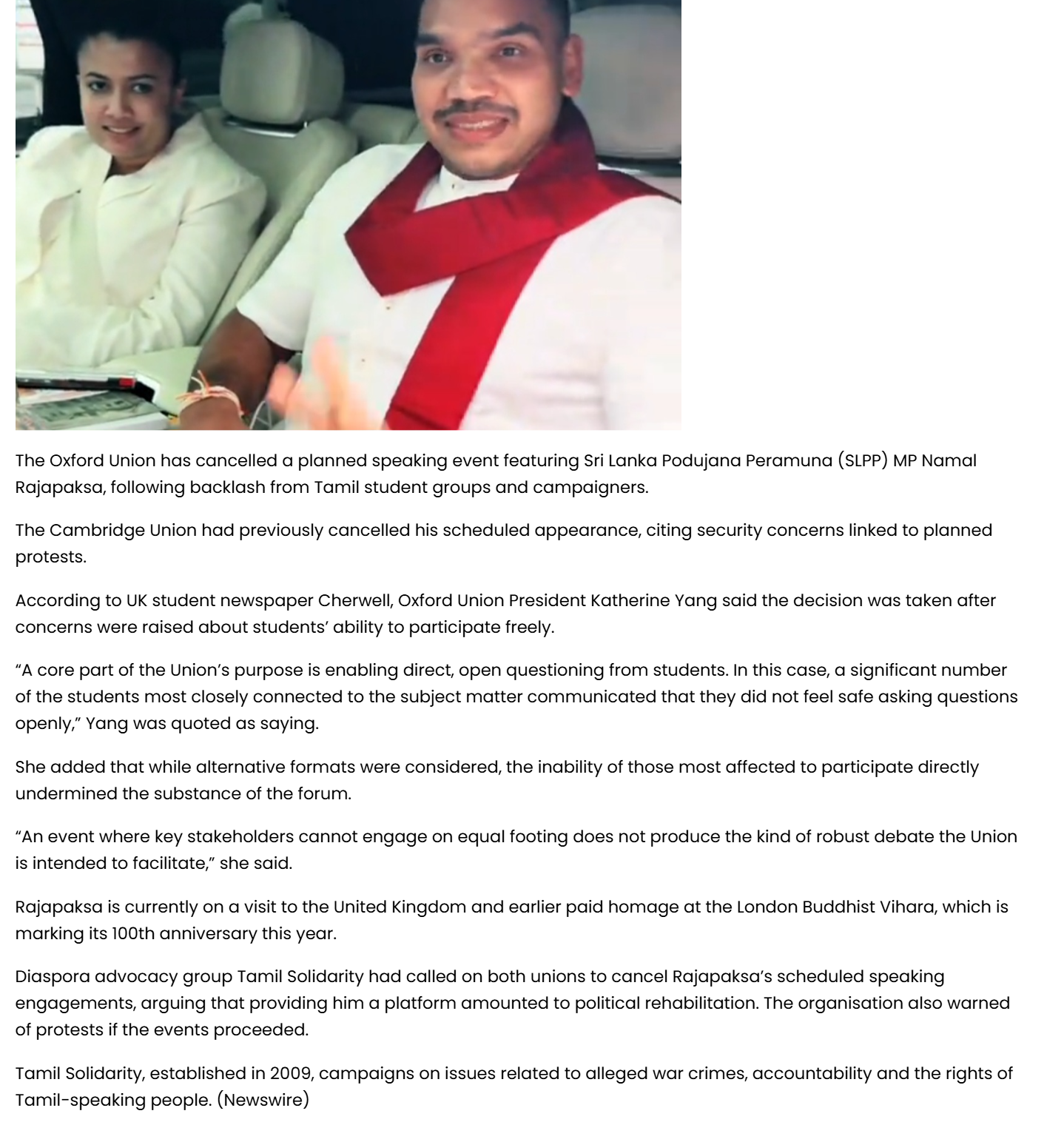
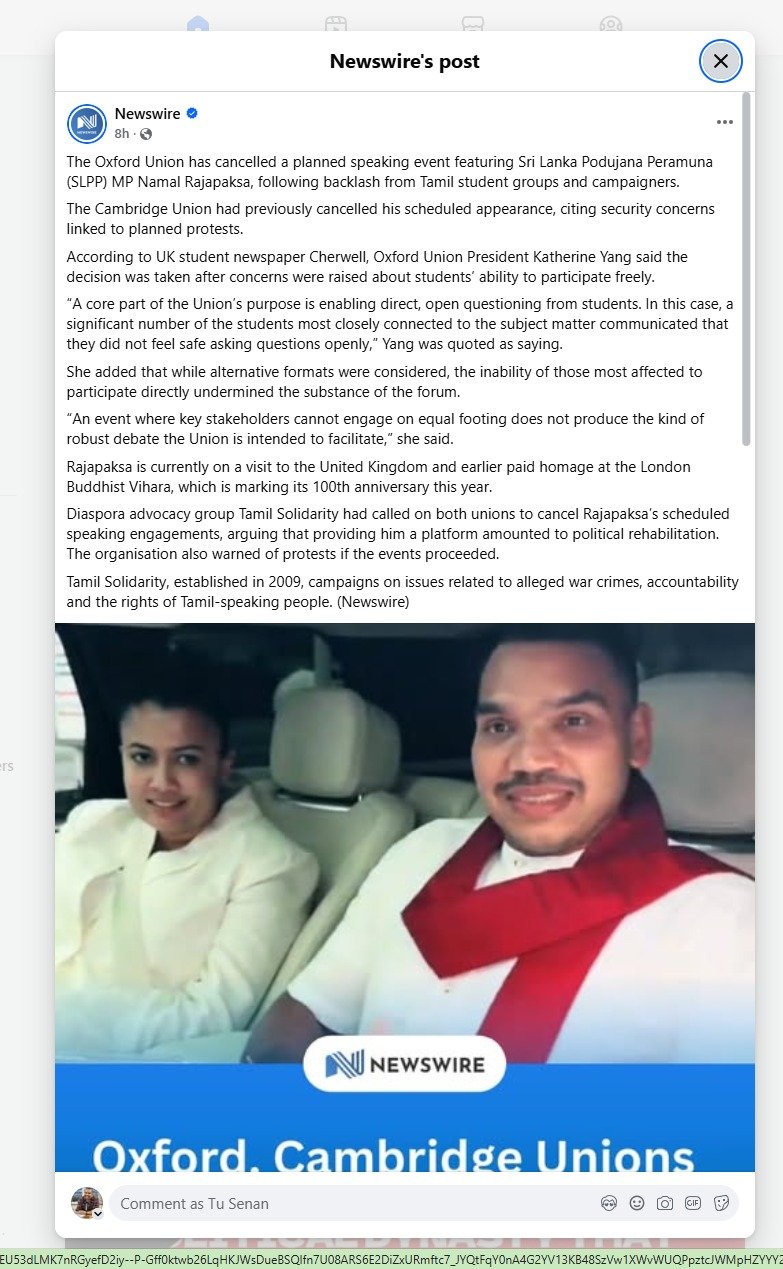
The Cambridge Union was the first to accept protesters’ arguments about how Namal would exploit the platform. In cancelling the event they stated: “We would like to assert in the strongest possible terms that none of our events are endorsements.” They also agreed it would not be a fair or genuine debate and that allowing it to proceed would give Namal ample opportunity to spread propaganda.
The Rajapaksa family has a history of refusing to answer serious questions or permit free speech. Interviews with Mahinda and Gotabaya Rajapaksa in international media (including BBC coverage) show they consistently evade key points and deny human‑rights violations, claiming those killed were LTTE fighters. When Sarath Fonseka—once an ally—criticised them, Gotabaya publicly threatened, “We will hang him.” It is no secret in Sri Lanka how this family has treated critics.
They are the antithesis of free speech. Under their administration, they compiled detailed information on activists in Britain and used it against them. Numerous political activists remain on lists and face reprisals. Anyone who dares to ask serious questions risks retaliation—not only from state agencies but from gangs linked to the family. The organisation of gangs to attack Aragalaya protesters is a public example. It has been common for Sri Lankan authorities to record and keep names and photos of serious critics. Their politics have been one of witch‑hunt and repression, not debate.
Students from victim families would be unable to attend due to the trauma it would cause; others would fear attending and see no point. Cambridge Union’s decision—“we don’t believe it’s possible to have a balanced and open discussion on this subject, and thus our Standing Committee made the decision to cancel this event”—is therefore correct and welcome. The Oxford Union also cancelled the event, stating: “An event where key stakeholders cannot engage on equal footing does not produce the kind of robust debate the Union is intended to facilitate.” This is the right direction for the unions to take.
Debate and democracy?
We respect and defend the right to free speech. Tamil Solidarity has consistently argued for discussion and debate to clarify truth and develop political understanding. We oppose “cancel culture” and out‑platforming people for political differences. One of our key demands has been freedom of speech and the right to assembly. Many Eelam Tamils know the value of free speech well: the Rajapaksas have historically denied them even the right to remember the dead. Journalists have been threatened, killed, and prosecuted for speaking out.
This is not an equal debate. Allowing Namal a high‑profile platform creates hype and gives him an opportunity to boast and propagandise. He is unlikely to say anything meaningful, either in his remarks or when answering questions. It is beside the point: an unequal platform creates a false equivalence between a defender of war crimes and his victims. The killing of tens of thousands is an indisputable fact; it is comparable to debating whether the earth is round. Sri Lankan news outlet – Sri Lanka Mirror Claims that war crimes “remain contested” and require examination in “historical context” are disingenuous. There is a broad body of evidence—from UN reports to award‑winning documentaries and books exist that explain the historical context vividly.
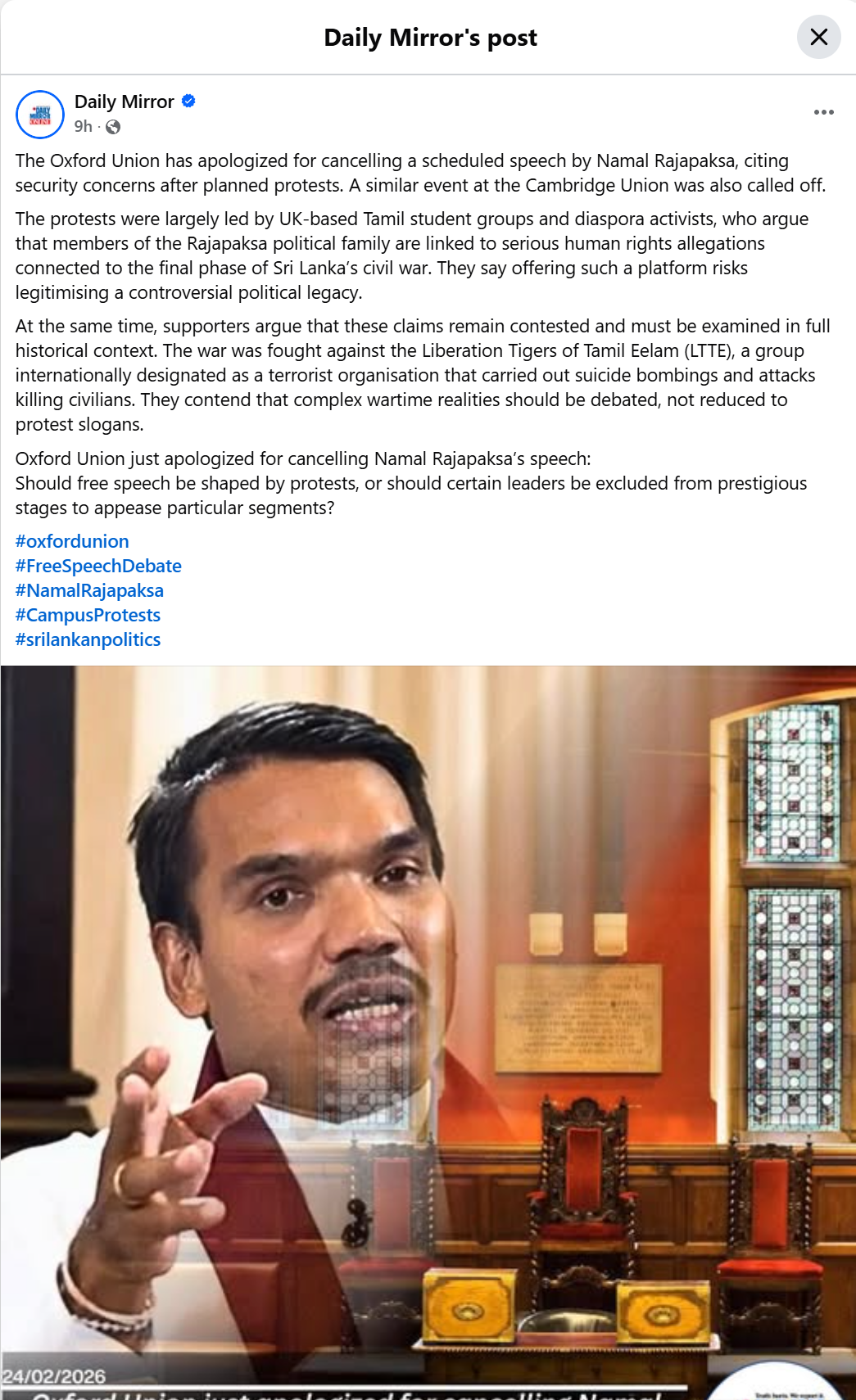
Mirror further suggested the debate should be about “complex wartime realities” rather than be “reduced to protest slogans.” For tens of thousands who lost loved ones, however, there is nothing complex about whether they were killed. They will not accept debating their deaths as if they were a matter of opinion.
Moreover, the Rajapaksas routinely label the entire Tamil population as terrorists and make threats. Many in the diaspora fear travelling to Sri Lanka to visit family. How can this be a free and open debate if participants and their relatives risk reprisals? What genuine questions could be answered? Reputable human‑rights organisations have been asking such questions for decades without satisfactory replies. Allowing Namal to appear would give him a platform to lie, deny, and rebrand himself; the SLPP would then present the appearance of an endorsement by UK institutions.
Look at how it is reported in Sri Lanka. Cherwell reported that Sri Lankan ministers attacked the cancellation as a “scar on the Oxford Union and the British government.” Many in Sri Lanka do not understand what the Oxford Union is; apparently even ministers do not. An SLPP politburo member claimed, “Tamil diaspora are afraid to allow Namal to clear these misconceptions, as their false narratives on certain issues will not hold any weight if he is given a fair platform,” denying facts and vilifying the diaspora as “liars” or “terrorist elements.” This is a familiar template used to silence critics—Milinda Rajapaksa framed the cancellation as occurring “amid threats from elements of the LTTE diaspora.”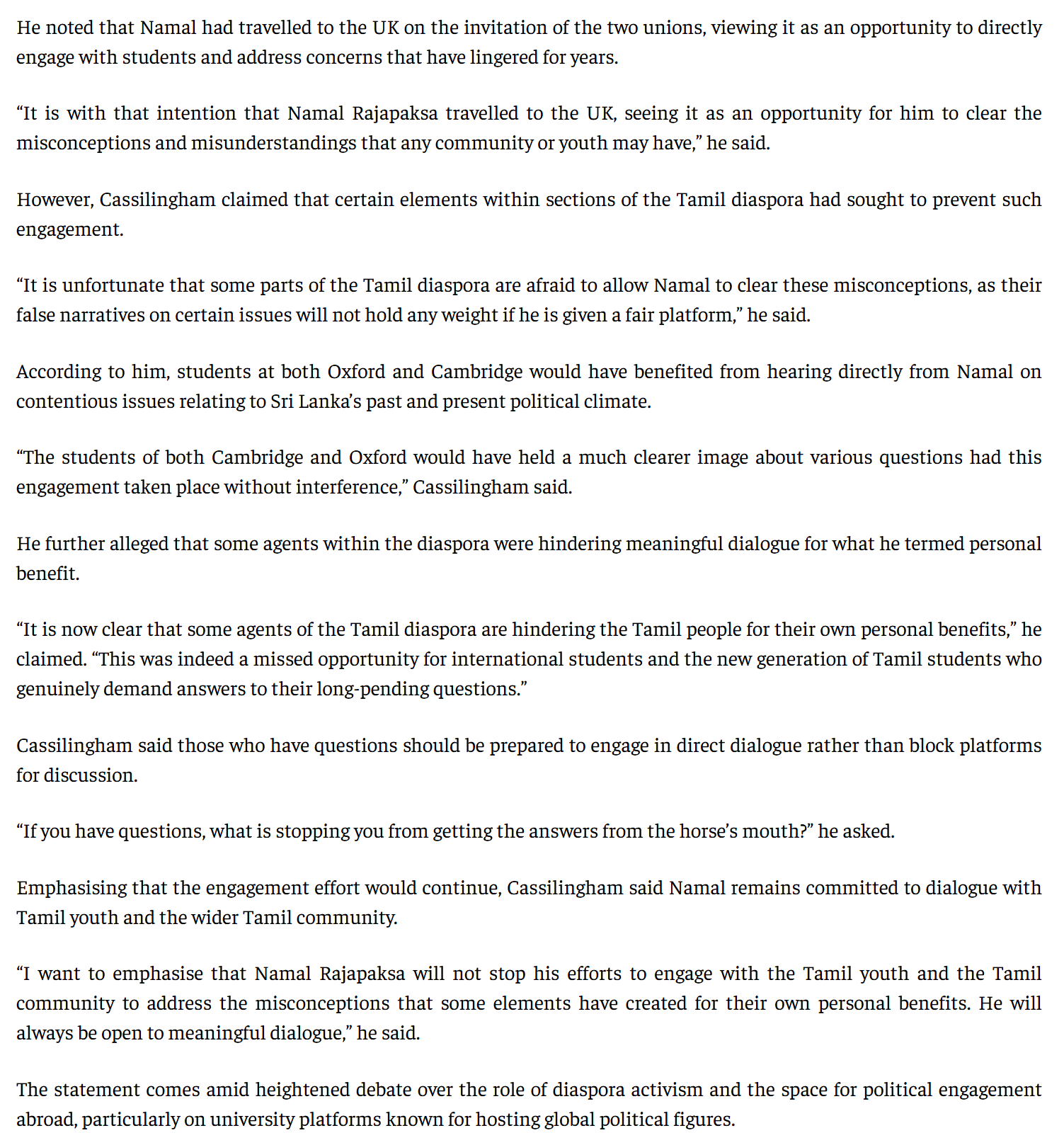
Beyond the Rajapaksas, their allies also denounce and vilify the Tamil diaspora. Why do they fear the diaspora? Because many in the diaspora can exercise free speech more freely than people inside Sri Lanka and can mobilise to demand justice—an ongoing threat to those who benefited from looting and repression.
Those defending Namal are often collaborators with the corrupt regime and act in their own interests. One Jaffna‑based site (claiming to be a news outlet) published a convoluted rant, arguing that war crimes are a moral issue while debating societies pursue “strategy.” It claimed history will remember the cancellation, but if the event had gone ahead it would have remembered the “questions”. This kind of ludicrous junk passed off as treasure is not new from those circles. As far as we understand, those behind the site have close links with defenders of the 2009 killings who offer a so‑called “neutral” argument that it was a war between the Tigers and the military and that the Tigers needed to be eliminated. We have also learned that the same site is linked to efforts to out‑platform anyone articulating Tamil national aspirations, labelling them Tamil nationalists and, by default, terrorist sympathisers.
Some other supporters of Namal argue that opposing Namal has strengthened chauvinist forces. Apparently the Tamil diaspora is to blame for rising Sinhala chauvinism! It is true that some human‑rights defenders have been wary of associating with the diaspora because state propaganda paints the diaspora as acting against the Sinhala population. In the past, human‑rights advocates were labelled “terrorist” sympathisers simply for diaspora connections. This time, however, that propaganda is weakened: many Sinhala youth and students also expressed outrage and joined the opposition. Who in their right mind would invite the Rajapaksas? Asked many.
In sum, the cancellation was justified given the imbalance of the forum, the trauma and security risks to victims and their families, the Rajapaksas’ history of repression and denial, and the real likelihood the event would serve as a propaganda platform.
NOTES
Who is Namal and what does he represent?
In a 2018 interview with the Indian Express, Namal Rajapaksa defended the mass murder of Tamils in 2009. He claimed “the war that was led by my father” was about “calculated damage, collateral damage.” By “collateral damage” he was referring to a calculated massacre. Tens of thousands of Tamils (estimates put the number at least 150,000) were surrounded on all sides by the military, boxed into a small lagoon, and indiscriminately bombed and killed. The entire population remaining in the area was held in makeshift military detention. Channel 4 and other media published visual evidence (rare, as media reporting was banned by then‑President and Namal’s father, Mahinda Rajapaksa) of heinous sexual abuses, the killing of children, and widespread torture that took place even after the end of the war. Sri Lanka saw one of the longest protests in history by mothers still demanding news of disappeared sons and daughters.
We are talking about more than 10% of the population in that area are brutally massacred, with the rest held under heavy military control. The passing years have not healed this wound. The Rajapaksa family continues to boast about these killings and to protect and promote those accused of war crimes. Since the war, this family created an atmosphere of fear and intimidation. The killing of journalist and Sunday Leader editor Lasantha Wickrematunge is one example of how critics were silenced. White‑van abductions, summary executions and political intimidation became the norm. So much so that the demand for the “right to live” became a key slogan in the freedom platform campaign that emerged at that time.
It is not only Tamils who hold huge grievances against this family, but many sections of society. The Rajapaksas are now known for rampant corruption and nepotism. At one point Rajapaksa brothers and other relatives controlled more than 70% of the national budget; five ministries were held by Rajapaksa brothers. They are accused of taking billions of dollars illegally out of the country and using binami (front) holders to stash looted wealth. This family is seen as having looted and broken the country, affecting tens of thousands of Sinhala workers and the poor. When the mass movement erupted in 2022, the main slogan was unsurprisingly “Gota go home” — referring to Gotabaya Rajapaksa, then president and the defence minister who led the genocidal war against Tamils. They organised brutal gangs and set them loose on protesters. This provocation intensified anger, and in some cases protesters retaliated by burning down family homes and luxury cars. Rajapaksa offspring, including Namal, possessed long lists of Rolls‑Royces, Lamborghinis, Ferraris, McLarens and other lavish displays of wealth while many poor Sinhala families were deciding which child could be educated and cutting meals.
The family has also been linked to the Easter bombing attacks in Colombo in 2019. They were accused of organising secret paramilitary or fundamentalist gangs to advance political aims. These attacks are said to have occurred with the blessing of the Rajapaksa family and contacts in the secret service and paramilitary networks, to secure Gotabaya Rajapaksa’s victory in the presidential election. Following the church bombings, the Muslim population in the country was scapegoated and a hostile atmosphere was created; racist rhetoric was whipped up. Many activists were arrested solely because of their Muslim identity. To this day, the Muslim population bears the consequences of that chauvinist campaign. The Rajapaksa family is also directly linked to the creation and promotion of the far‑right Sinhala‑Buddhist organisation Bodu Bala Sena, which was responsible for anti‑Muslim riots in 2014.
The Rajapaksas continued state discrimination against hill‑country workers. Fundamental rights such as equal citizenship and land rights are denied to many. Despite being central to the tea‑production economy, hill‑country workers live on poverty wages and in dire conditions. Namal described protesters outside the Sri Lankan High Commission in London as “Indian Tamils” (Indian Express interview, 2018), claiming they spoke Indian Tamil rather than Jaffna Tamil — despite not speaking or understanding Tamil well enough to make that distinction. The Sri Lankan embassy has taken videos and photos and collected information on protesters, which has been used to carry out reprisals against protesters and their families in Sri Lanka. Namal follows this ignorance and labels hill‑country Tamil‑speaking protesters as “Indian Tamils.” Such is the level of understanding displayed by this family and their cronies.
Plotting the return?
The Rajapaksa brothers and entire family was rejected and driven out by the Aragalaya mass movement in 2022. One brother’s attempt to flee the country was blocked at the airport; Gotabaya went into hiding with help from loyal military and navy personnel. Members of Namal’s family also fled. But sections of corrupt government institutions, parts of the press, and personnel in the defence and secret services who benefited from the looting still protect the family and work to rebuild their “reputation.” Ranil Wickremesinghe, who took over soon after the mass action, protected the family (hence activists call him “Ranil Rajapaksa”).
Rejection of the family was evident in the last presidential election: Namal Rajapaksa, the SLPP candidate, won just 2.57% (342,781) of the vote despite huge spending. Gotabaya previously claimed they did not need Tamil or Muslim votes and could win with only Sinhala votes, assuming control of Sinhala workers and the poor. But it was those very masses of Sinhala workers and poor who chased them out and ended their political authority—at least for a time.
The current NPP government led by the JVP, with its chauvinist core, has so far refused to take action against the family, effectively giving them room to regroup. There is evidence of crimes, but insufficient political will or confidence to prosecute. Namal could face a minor sentence as early as July; however, he and other Rajapaksas generally have escaped accountability for mass murder, money laundering and other serious crimes. Namal has been arrested several times: caught red‑handed over bribes related to a property venture (released on bail and never prosecuted), arrested in 2016 for alleged money laundering, and arrested for damaging public property. Numerous allegations of corruption, abuse and even murder against him remain unresolved. He has been unable to provide evidence of his innocence and is also accused of forging a degree certificate. The so‑called “Blue Brigade,” formed by Namal as the SLPP youth wing, is accused of various violent acts, including sexual abuses. The list of allegations is long and public, yet the political establishment protects its own and they get away with these crimes.
Reestablishing political control would allow them to continue evading accountability. Now that the Rajapaksa brothers are widely exposed and hated in the country, their remaining allies are carefully promoting a plan to restore the family’s power. Their hope rests with Namal as the principal figure. There is no credible way to create a “clean image,” but the establishment can exploit chauvinism—presented as “patriotism”—as a political shortcut. By stoking Sinhala‑Buddhist nationalism and portraying Tamils as an imagined “terrorist” threat, they hope to regain the base they held under Mahinda Rajapaksa. Days before Namal arrived in London, he proudly declared himself a “Sinhala Buddhist,” pandering to chauvinist elements. In the Sri Lankan context, declaring that identity is more than personal—it signals alignment with openly racist Sinhala‑Buddhist organisations. It is no secret that the SLPP has a history of using Sinhala‑Buddhist chauvinism.
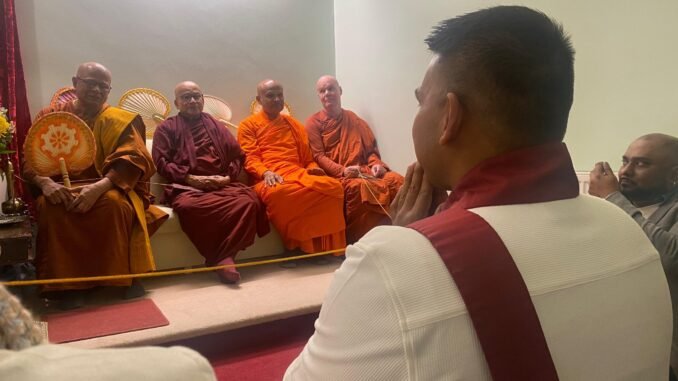
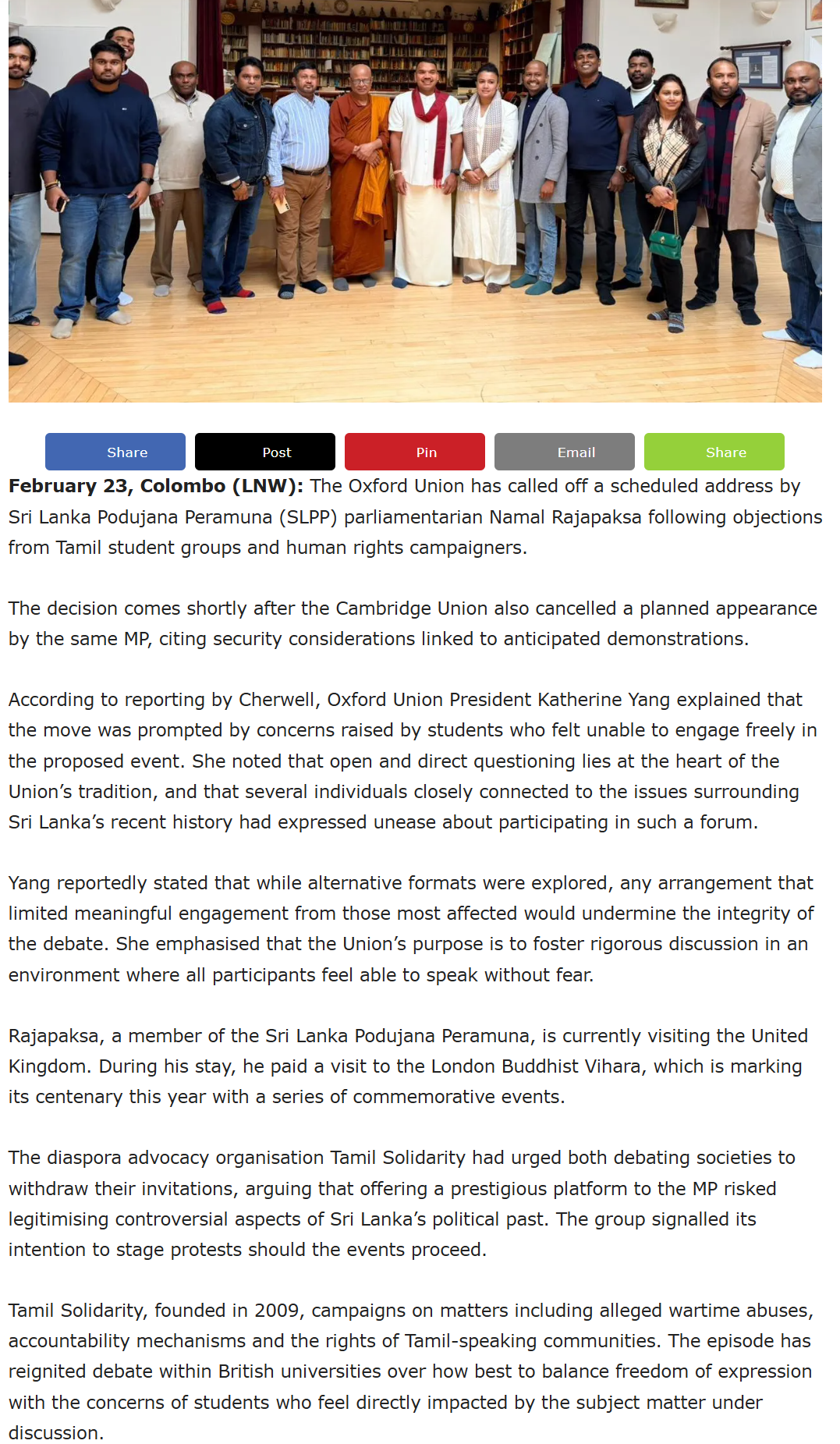
Namal and his allies are also trying to portray him as a “modern,” “reformed” leader. Yet he has not distanced himself from the Rajapaksas or their crimes; on the contrary, he doubles down as a defender of their past, Sinhala Buddhist nationalism, and Sri Lankan nationalism. Part of the legitimisation strategy involves religious events and public meetings, and attempts to gain prestige by speaking at forums such as the Oxford and Cambridge Unions. Although those events are organised by the unions and not the universities themselves, in Sri Lanka his appearance would be presented as international validation—portraying him as a heroic intellectual honoured by the world’s leading institutions.